Sep 072011


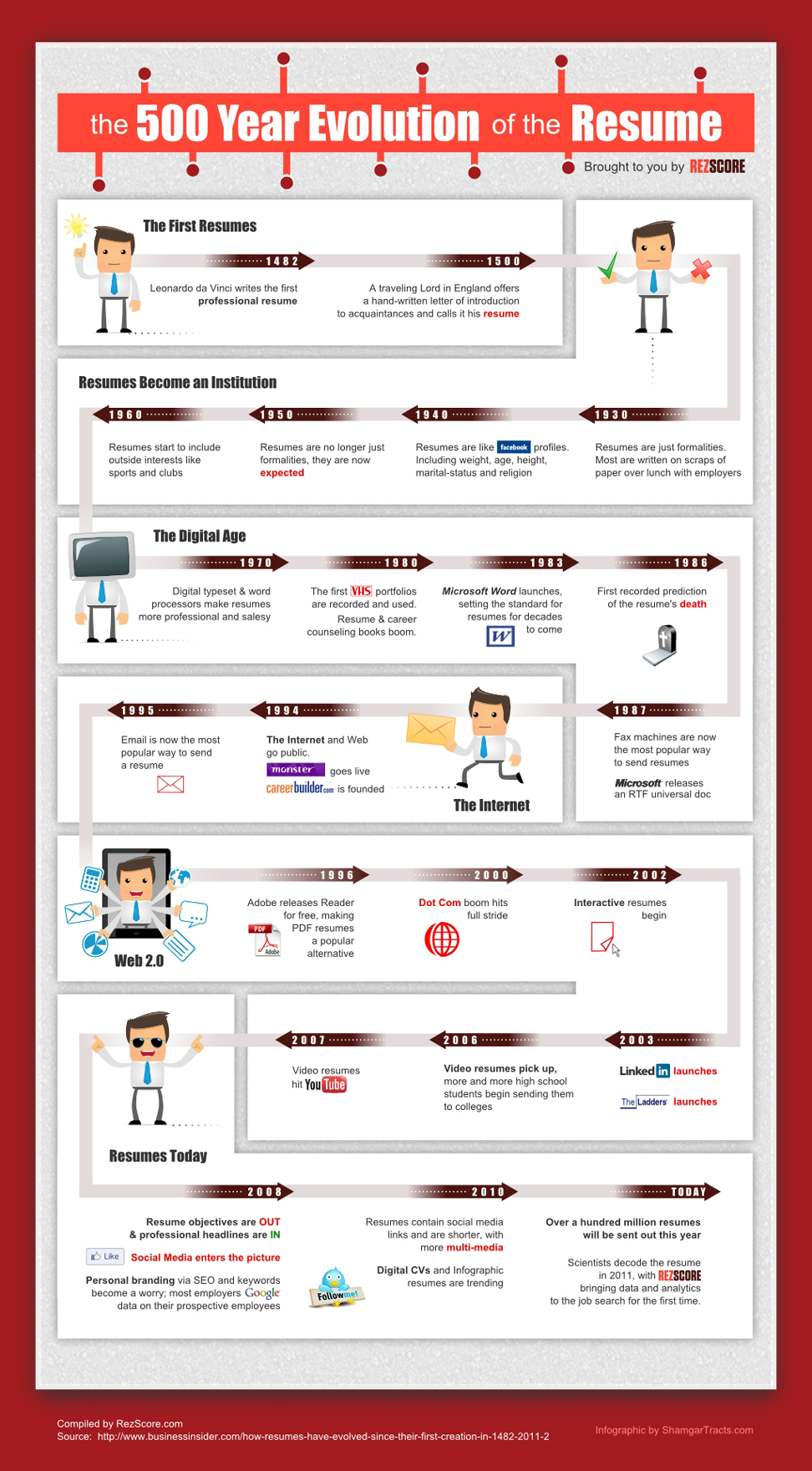
The role of the resume has remained constant throughout its 500 years of existence — the point of the resume is to get an interview, in hopes of finally landing a job.

Relative to other forms of communication, though, it hasn’t changed all that much. In fact, most of the changes have been merely cosmetic — most employers still require a one-sheet, black-and-white printed resume at interviews, regardless of the fact that we all use email and have had access to much better design options for years now.

via The Modern History of the Resume [INFOGRAPHIC].

Sep 062011


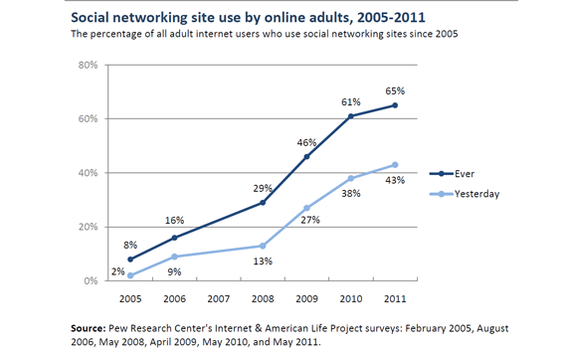
According to a new study, 65 percent of American adult Internet users have interacted on a social media site like Facebook, Google+, or LinkedIn, supporting the often cited importance of social media marketing.

The social networking report from the Pew Internet & American Life Project has been asking adult Internet users in the United States about social media site visits since 2005 when just 8 percent of Internet users 18-years-old or older had visited one of the sites, compared with 65 percent just six years later. What’s more, for the first time, more than half of all American adults — Internet user or not — has visited a site like Facebook, LinkedIn, or Google+.

via Adult Internet Users Are Socialites, Study Finds | Practical eCommerce.

Sep 062011


Unfortunately, as evidenced in the video embedded below, a newly appointed Page admin can remove the Page creator’s admin status, which can be very nasty in certain cases. Today, Facebook Pages are more than fun, they’re a serious part of business promotion and losing administrative access to a Page can lead to host of problems.

via Facebook Flaw Lets You Hijack Page from Original Owner.

Aug 312011
 

Imagine you found a great deal on a flux capacitor. Not only does it make time travel possible, but the new version is able to freeze time and only requires half a gigawatt to operate. Plus, it’s 33 percent cheaper than the one Doc Brown built into the DeLorean. Sounds like a no brainer, until you read a couple online reviews claiming it set their cars on fire. And so you remove it from your shopping cart. This isn’t unusual, and according to a new study, it happens far more often than not.

via Maximum PC | Study: Negative Online Reviews Influence 80 Percent of Shoppers.

Aug 312011


Naturally, there are a lot of restaurants on the world’s largest social network, though there could be a lot more, and many of the ones that do have Facebook Pages could be better. To that end, Mashable spoke with social media stars from the hospitality industry about some best practices when it comes to Facebooking food.

via 13 Best Practices for Restaurants on Facebook.

Aug 312011


Maybe Steve Jobs was on to something when he refused to hide away his disappointment or displeasure. That, at least, is the takeaway of a new paper by Matthijs Baas, Carsten De Dreu, and Bernard Nijstad in The Journal of Experimental Social Psychology. Their first experiment was straightforward, demonstrating that anger was better at promoting “unstructured thinking” on a creativity task, at least when compared to sadness or a neutral mood. The second experiment elicited anger directly in the subjects, before asking them to brainstorm on ways to improve the condition of the natural environment. Once again, people who felt angry generated more ideas. These ideas were also deemed more original, as they were thought of by less than 1 percent of the subjects.

via The Creativity of Anger | Wired Science | Wired.com.

Aug 312011


Every website needs a favicon, if for no other reason than to avoid littering your server logs with 404 errors. If you still haven’t got a favicon on your site, check out Faviconist, a new favicon generator from developer Michael Mahemoff.

via Faviconist: Create Beautiful Favicons with HTML5 | Webmonkey | Wired.com.

Aug 262011
 

Earlier this month, Business Insider published an article that further exposed the dirty little secret of online advertising: Brands are paying for ads that show up in very inappropriate locations. Maybe inappropriate is the wrong word. I mean really, really bad content — the kind that, if viewed at work, could get you fired.

via 5 horrible ad placements that could have been avoided – iMediaConnection.com.

Aug 262011
 

Marketers know that the art of positioning a brand involves designing an image and or an offer to occupy a distinctive place in the mind of a specific target market. Great positioning doesn’t appeal to everyone — rather, it appeals more intensely to fewer people, but the right people — the main people you are targeting. To begin with, it is paramount to perform a self assessment of principles, values, strengths, weaknesses, ethics, and eccentricities that will establish who you are in the eyes of others.

via How to transform yourself into a brand – iMediaConnection.com.