
Jul 242012
 

Now, there are three data points that are publicly available for developing a lousy scale for YouTube brand channels: video views, subscribers, and uploaded videos.

I quickly decided against using “video views.” This seems like a more appropriate metric for comparing individual YouTube videos.

“Subscribers” is a more appropriate metric for comparing YouTube channels. Users subscribe to channels to receive updates and stay informed when something new occurs. Subscribers are consistently more engaged with a brand’s content and watch a brand’s videos on a regular basis.

VidStatsX provides a list of the top 2,000 most-subscribed YouTube channels. It also provides lists of the top 100 most-subscribed YouTube channels in 16 categories.

But, some YouTube brand channels were launched earlier than others, giving them a head start in adding subscribers. And is a channel lousy simply because it hasn’t made it to one of these lists yet?

On May 20, 2012, the YouTube Blog said there were “tens of millions of channels on YouTube.” So, even if a YouTube brand channel doesn’t make it to bottom of the top 100 most-subscribed YouTube channel’s list in its category, it might still be pretty good.

This is where “uploaded videos” factors into the lousy scale.

A very good YouTube brand channel should be able to generate more subscribers per uploaded video than other channels in its category. This means that a really bad — or lousy — channel would be one that has generated fewer subscribers per uploaded video than its competitors.

This methodology lets you calculate the equivalent of the batting average for a YouTube brand channel.

A pretty lousy branded YouTube channel in the auto and vehicle category

To take my new lousy scale out for a test drive, I started in YouTube’s automotive category. To my surprise, here’s what I found:

 Brand  Subscribers  Videos  Subscribers/Video

Audi Deutschland  95,173  893  106.6

Chevrolet  81,799  1,321  61.9

Mercedes-Benz  72,126  112  644.0

Ford  68,966  347  198.7

Honda  68,018  289  235.4

Cadillac  43,762  198  221.0

Hyundai USA  40,256  333  120.9

Toyota Deutschland  39,651  214  185.3

Volkswagen USA  36,535  211  173.2

Buick  2,059  434  4.7

Based on this data, Buick’s branded YouTube channel is pretty lousy. It has the lowest number of subscribers per video in the autos and vehicles category. By comparison, the Mercedes-Benz channel has generated 137 times more subscribers per video.

MORE:  3 lousy branded YouTube channels


Jul 232012
 

While search engine marketing and optimization are critical elements of marketers’ branding efforts through Google, other sites, such as Google+ and Twitter, offer additional branding opportunities. In particular, Facebook provides the best example of the benefits of building brand identity within a destination site.

The outreaching brand

On Facebook, marketers were quick to launch branded pages linking to their own websites. The traffic to their Facebook pages quickly took off. However, consumers don’t always want to leave the Facebook site to click out to individual business websites — in many cases, they are happier to interact with the brand in the Facebook environment. The key was to bring the brand to the consumer.

Today, successful brands go where consumers congregate rather than wait for consumers to come to them. This requires building up an extensive brand presence within consolidated sites — in essence, syndicating the brand experience on digital properties outside of their business’s own domain. Brands such as Coca-Cola, Disney, and Starbucks have been successful in creating powerful brand destinations within Facebook, with ever-growing fan bases of more than 20 million each.

MORE:  How to avoid being lost in the digital crowd


Jul 232012
 

It’s a big internet. There’s always something new going on, and there’s always something new you need to understand. So what is the essential reading list for people who want to make sense of the digital world? That’s what you’re going to find in this article. And while you might already be familiar with some of these blogs, there are almost certainly others that you haven’t come across before.

Of course, this list isn’t comprehensive. In fact, it’s a starting point. That’s where you come in, dear reader. I know you have a few of your own blogs that are go-to sources for information. All I ask is that you be so kind as to share your essential reading list with the rest of the community in the comments section.

Tech and business
I’m sure you know the usual suspects in this category, such as The WSJ’s All Things Digital blog, TechCrunch, The NY Times Bits Blog, and PaidContent. But the truth is that good tech news and business analysis doesn’t have to come from a major media company. In fact, some of the best information comes directly from the trenches.e best information comes directly from the trenches.

MORE:  16 lesser-known marketing blogs you should read


Jul 172012
 

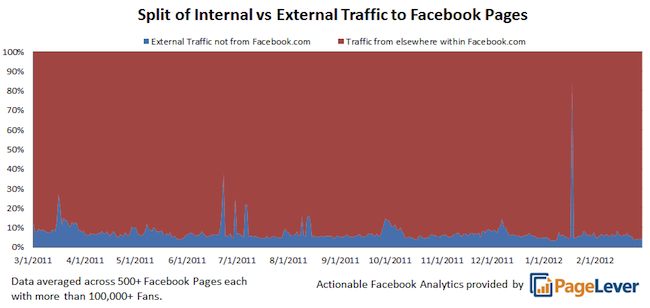
About 5 to 10 percent of traffic to Facebook pages comes from external sources rather than from within Facebook, according to data from PageLever.

The Facebook analytics company looked at 500 Facebook pages each with more than 100,000 fans and found that the average of 7.56 percent of traffic to pages came from external referrals between March 2011 and February 2012.


MORE: Less than 10 percent of traffic to Facebook pages comes from outside Facebook.com.


Jul 172012
 

What makes for a great post in social media? It’s the question that haunts community managers and marketing directors. First, the bad news. You know it. I know it. But I have to point it out: The most effective posts and updates are going to depend on your community. If you have good analytics reporting and pay attention to your fans, you’ll figure it out eventually. (More good info on this here.)

Now, for the good news: There are, in fact, a few magic bullets for Facebook and Twitter. The following discussion covers only Twitter and Facebook. The best research is available for these two platforms more than any others. So let’s take a look at some of the available data to find the buzzwords that ignite your social media followers.

The buzzwords: “Please” and “thank you”

Why they’re powerful

Didn’t your mother teach you anything? Sheesh. The exact same behavior that keeps everyone in the real word from thinking that you’re an asshole applies to the social media world too. Every time you post content for your fans, you are implicitly asking, “Take time from your day and look at this thing that I just posted.” You’re asking them to do something for you, so say “please.” And if they engage, say “thank you.”

MORE:  9 buzzwords that ignite followers (single page view) – iMediaConnection.com.


Jul 172012
 

People tend to start with the most well known, i.e. Facebook or Twitter, or they set up profiles on lots of different platforms and then struggle to keep them updated. This is what I would call a ‘tools first’ approach and it should be avoided if you want to get the best out of your social media activity.

There are two problems with this approach. First, you’re making an assumption that your target audience is actually using the platform. And second, if you are working with a small team, or on your own, it’s going to be a struggle to keep all of your profiles and pages effectively updated.

Before you do anything, start with your objectives; what are you trying to achieve? Do you want to drive traffic to your site? If so, which page do you want to drive them to? Or maybe you want to use social media to help drive new business enquiries or to position yourself as an expert in a particular subject.

Being clear on what you’re trying to achieve will make it much more likely that you will be successful.

via Choosing your social network | Opinion | .net magazine.


Jul 112012
 

Facebook recently added an option for pages to make “unpublished” posts through the Pages API. Unpublished posts do not appear on a page’s Timeline or in fans’ News Feeds, but they can be promoted with ads.

Facebook ad and page management platforms can integrate this feature to help page owners test different creative options. Previously, page owners using the self-serve ad tool or Ads API could not run page-post ads without creating a post that would also show up in fans’ feeds. Now, for instance, a business can target non-fans with an ad that includes an intro video that might not be relevant to users who have already Liked the page.

MORE:  Facebook now allows pages to make ‘unpublished’ posts to test creative options.


Jul 092012
 

In a recent blog post, John Battelle writes, “Display advertising is dead. Or put more accurately, the world of ‘boxes and rectangles’ is dead. No one pays attention to banner ads, the reasoning goes, and the model never really worked in the first place (except for direct response). Brand marketers are demanding more for their money, and standard display is simply not delivering. After nearly 20 years, it’s time to bury the banner, and move on to…well something else.”

As a director of digital media at Rosetta, a focus of my role is on display and its role within our clients’ media mix, so reading John’s article raised some questions for me. If he’s right, and “display is dead,” what’s the next phase of digital marketing? I think the answer to that question depends largely on the advertiser’s business objective.

MORE:  Is display really dead? – iMediaConnection.com.


Jul 062012
 

Presumably, no Democratic candidate wants to appear on the conservative Breitbart website, and no cruise line wanted its ad to accompany a story on the January Costa Concordia cruise ship disaster, but both have happened. Both Google and LiveRail, the the real-time video ad platform for publishers, networks and agencies, made announcements on Tuesday about ad blocking technology that allows publishers to filter “inappropriate” or simply ill-suited ads from ther pages.

LiveRail unveiled its “Checkpoint” tool that lets premium video publishers control which advertisers and video creatives are delivered within their private exchange or real-time bidding (RTB) environments, with the ability to block unwanted ads before serving them to a viewer.

The technology allows publishers to quarantine and block potentially inappropriate ads from categories like alcohol and tobacco, or those containing violent or risqué content, which may have otherwise been served to viewers from third-party buyers like ad networks and DSPs.

MORE: LiveRail, Google Make Publisher-Side Ad Blocking Announcements – MarketingVOX.


Jul 052012
 

Wildfire has run hundreds of successful campaigns for brands across all three networks and can share with us exactly what works and what doesn’t. In Part 1 of their Social Advertising series, part of the Adrants white paper series, the reports shares:

- Best practices for writing ad copy
– Which creative images are most popular with audiences
– The differences in layout and styling on Facebook, Twitter, and LinkedIn
– What not to do when advertising on Facebook

MORE: How to Create Successful Facebook, Twitter and LinkedIn Ads – Adrants.