May 142012
 

Anything that can boast a 112% higher engagement is worth a second look. That is just one of the figures that Simply Measured (the social media analytics firm) released yesterday. Since February, two more brands from the Interbrand Top 100 list (Xerox and Nike) have activated pages, bringing the total to 64 of those 100. (The top 10 for Google+ engagement include Nike, Coke, Starbucks, Adidas and Ferrari, among others.) Also since February, average weekly circler engagement is up 112%, and content engagement is up 65%. Finally, 22% of the brands now have circler counts over 100,000, up from 13% including Nike, and after just two months. So it appears brands are prioritizing Google+ and trying to capitalize on participation.

But, as Josh Sternberg of Digiday describes, smart brands actively strategize on Google+, rather than treat it as yet another presence they need to fill. ESPN for example has 1.2 million Google+ followers. Sports fans like rich media, and ESPN knows that, so relies on high-quality images and videos of all-things sport, and interactions with fans.

The news media seems not to know what to make of it, and the highly-circulated Wall Street Journal, New York Times and USA Today have piddling followings on Google+ compared to their other social platforms.

SOURCE: Dismiss Google+ At Your Own Risk – MarketingVOX.


May 142012
 

These days, more Kickstarter campaigns are achieving success than we can keep track of. The iPhone-friendly Pebble watch earned $7.6 million more than its $100,000 goal. And the Galileo iPhone platform closed its Kickstarter campaign at $702,000, far surpassing its $100,000 goal.

Not to mention, Kickstarter recently reported it has raised $200 million from over 2 million backers.

How does one cash in literally on the Kickstarter craze? For starters, it helps to have a unique concept, wicked ambition and one unforgettable pitch. The great news is that Kickstarter provides great tools to showcase all of the above.

We’ve read all of Kickstarter’s guidelines, FAQs and tips, and have researched testimonials from successful campaign alums to compile a set of tips that will help launch you into the Kickstarter hall of fame.

SOURCE:  9 Essential Steps for a Killer Kickstarter Campaign.


May 092012
 

Though most companies today have some kind of online presence, 22 percent of marketers find that getting buy-in for online content marketing is still their greatest challenge. Even if there’s enough buy-in to give it a shot, marketers still need to convince their companies to invest in the staff and resources that will make online marketing possible. Successful online content marketing begins by convincing your own company that the ROI merits the investment.

via How to convince your boss to fund content marketing – iMediaConnection.com.

May 092012
 

Companies that neglect Timelines brand-friendly attributes will fall victim to the ever-distracted nature of the online consumer. At Socialbakers, we continuously analyze social media data to determine how brands can maximize their social media investments by posting engaging content to the most influential online users. Based on millions of points of global data, we have found the following mistakes cause the greatest hindrance to a companys success in using Timeline.

SOURCE: 5 blunders your brand is making on Facebook Timeline single page view – iMediaConnection.com.


May 082012
 

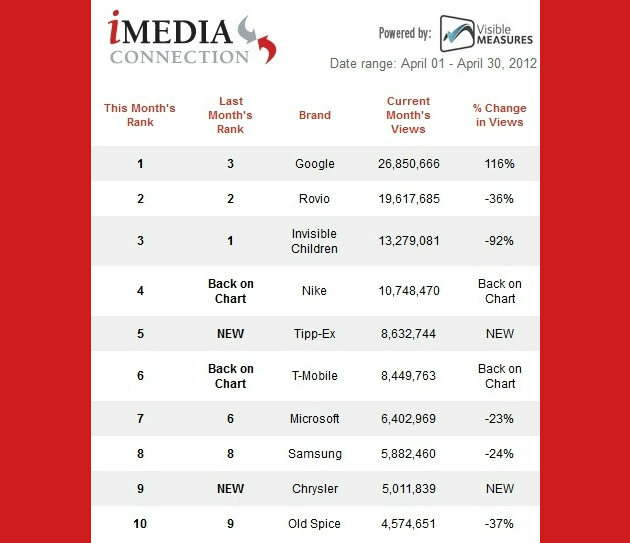
In April, the Top Brands in Video chart saw debuts from Chrysler, a long-established American brand, and Tipp-Ex, a lesser-known European brand aiming to make an impact in social video. Additionally, Nike and T-Mobile made comebacks after short hiatuses from the top 10 slots.

Powered by data from Visible Measures, this monthly chart looks at the most-watched brands in online video, across all of their campaigns.

SOURCE: The top 10 hottest brands in online video (single page view) – iMediaConnection.com.


May 072012
 

The idea, in a nutshell, is that brands of all categories must adapt to the new publishing model and morph into something akin to their entertainment cousins if they are to survive and thrive in a media environment where it gets harder everyday to capture a consumer’s attention. Brands that had their own YouTube channels were viewed as cutting edge 18 months ago — or maybe even a little beyond the cutting edge. Today, few people ask whether a brand should have a YouTube channel. Instead, the question is, what should a brand do with its YouTube channel?

While that’s ultimately a question for each brand (and the agencies that handle their business) to answer, there are several larger questions brands should be asking about their YouTube channels. After all, a handful of brands are clearly engaging as if they’ve been in the content business for years, but many more are quite obviously stuck in neutral. So to help your brand take a look at its YouTube channel with fresh eyes, I’ve asked several agencies to share what they believe are some of the fundamental concerns to focus on when planning a YouTube channel.

SOURCE: 6 lessons in launching a branded YouTube channel (single page view) – iMediaConnection.com.


May 022012
 

Today’s web does not limit the act of curation to those with a doctorate degree. Anyone and everyone can, and do, curate using everything from bookmarking sites to social networks. “Social curation,” as we call it, is simply the act of sharing, categorizing, and spreading content to others. The content can be your own or someone else’s. And, because you are sharing content that lives in its place of origin via linking, it is not considered stealing.

Why do people spend hours online bookmarking, pinning, and reposting? The answer is different for everyone, but we can be sure that it’s for the same reason a woman might show off her shoe closet to a friend to hear, “OMG, those are so cute where did you find these?!” Or, a man might sit through an entire dinner carefully talking through the history of aviation and the ins and outs of his profession. We all want to be recognized for our expertise, talents, and savvy. Posting content we care about displays our creativity, interests, opinions, and personality. Being social creatures, we naturally want to share the best of things with our circles and get recognition for the good find. On the receiving end, people enjoy discovering and exploring things that are highly relevant and interesting.

Of course, when human behavior shifts, brands are quick to follow suit. In this article, we’ll discuss how marketers can get in on the social curation boom in a meaningful way.

There are a lot of websites out there offering curation-type services. They crop up and disappear with the latest craze. To get a clear sense of how a brand might leverage curation, we can break them down into categories.

SOURCE:  8 social curation tricks for Pinterest and beyond (single page view) – iMediaConnection.com.


May 022012
 

Paid click campaigns are valuable traffic drivers, but they could be doing a lot more considering that half the time they don’t work. Research my company conducted indicates that non-branded paid clicks have a 55% bounce rate from their landing pages. Google Analytics and KISSmetrics reports put the range from 10% to 90% with new visitors bouncing 62.9% of the time from paid search clicks.

What these numbers indicate is that only about half of paid clicks actually drive conversion from new visitors they attract. That is the equivalent of throwing away $.55 of every marketing dollar. That’s not to say paid clicks aren’t a good idea, but rather that they can and should be more effective and efficient.

According to Conductor, an SEO platform, there’s an average online conversion rate of just 2.5% for visitors across all channels. Marketers need to invest in resources that maximize conversion from paid search traffic, often their largest digital line item. In paid search, there are two ways to bid: exact match or broad match.

The choice means most paid search marketers are forced to choose between scale and profitability, depending on how they bid. Exact match can offer profitability but lacks scale and it only wins if the query matches the exact keywords you chose. Broad match includes other content too, which is why it offers great scale, but it’s less profitable because it’s not as accurate.

SOURCE: Why Pay-Per-Click Ads Are Wasting Your Money.


Apr 272012
 

 Mass market paperbacks may be taking a serious hit in sales these days, but check out this infographic showing the explosive growth in e books.

Online Marketing Trends: Digital E Books See 117% Increase..

Apr 252012
 

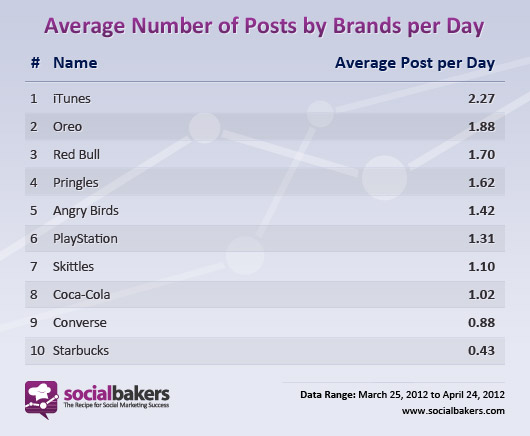
To engage your fans, you need to post enough content but not too much at the same time. Is there a magical number for the ideal number of posts on Facebook?

No, there is no magical number. The average number of posts tends to range between 2 – 3 posts a day but there are just too many factors that affect the engagement of a post to say that it works for each brand. So what is the right frequency?

Below are the average numbers of posts per day by the top 10 Brands and Media on Facebook. We have gathered data from last month, from March 25th to April 24th 2012.

SOURCE: How Often Should You Post On Your Wall To Engage Fans? – Socialbakers.