Apparently this new ad for the soda is getting panned. I don’t know, I laughed.

Apparently this new ad for the soda is getting panned. I don’t know, I laughed.

When illegal downloaders illegally downloaded an illegal copy of the illegal Deus Ex: Human Revolution beta, they illegally enjoyed themselves for the first few illegal levels before the game was all like, “lol j/k” and kicked them out to a Web-based form that started asking them all kinds of probing questions about their illegal activities, courtesy of a startup anti-piracy firm called Anti-Piracy Strategies.
The strangest part, though, was that 90% of the victims actually went and filled out the questionnaire rather than ripping their ethernet cords out of the wall, encasing their hard drives in blocks of concrete, and dumping them into the nearest major body of water like I would have done.
via Anti-piracy company pirates a million copies of Deus Ex | DVICE.
The standard line that Digital Rights Management (DRM) functions as a bulwark against online music piracy is being challenged by a trio of economists from Rice and Duke Universities. Their game theory research sides with a growing sentiment that DRM technologies which restrict music file copying and moving sometimes encourage illegal file sharing instead.
“In many cases, DRM restrictions prevent legal users from doing something as normal as making backup copies of their music,” contends one of the researchers, Dinahy Vernik, assistant professor of marketing at Rice’s Jones Graduate School of Business. “Because of these inconveniences, some consumers choose to pirate.”
The paper in question is titled “Music Downloads and the Flip Side of Digital Rights Management Protection.”
Under certain conditions, “we find that eliminating DRM restrictions can lead to an increase in sales of legal downloads, a decrease in sales of traditional CDs, and a decrease in piracy,” conclude marketing scholars Vernik and Devavrat Purohit and Preyas Desai of Duke. “This is in stark contrast to the view that removing DRM will unconditionally increase the level of piracy.”
via A game we all win: Dumping DRM can increase sales while reducing piracy.

As the London Evening Standard reports, it’s just a small “pop up” store within a U.K. computer retailer called PC World. Right now, it only sells Chromebooks and headphones, and it will only run for a few months until Christmas.
It’s called the Chrome Zone — the same name as the outlets in several U.S. airports that let you pick up a Chromebook before you fly out on Virgin Airlines.
It’s just an experiment for now. According to a Google spokesperson “It’s something Google is going to play with and see where it leads.”
via World’s First Google Retail Store Opens in London | Online Marketing Trends.
The Sunday circulars and coupons are a main reason why it is the most popular day of the week for newspapers. Consumers, it appears, have been trained to behave similarly on that day online as well, a blog post from Compete notes. Despite the steady drop in newspaper readers, consumers still flock to retailers’ sites such as Target or Best Buy to check for coupons on Sunday, Compete found.
“Based on the huge spikes in traffic on Sundays, it appears that consumer awareness of Sunday as the start of a new week of sales still appears to be strong. Sunday is one of the busiest days for consumers to visit both sites.”
via Sunday Still Drives Weekly Product Cycle – Even Online – MarketingVOX.

Search engine optimization isn’t exactly something you can major in — at least, not yet. In fact, many professional search engine optimizers are self-taught. They’ve supplemented backgrounds in marketing, computer science and the like with self-education via online courses, videos and blog posts.
Whether you’re looking to build your knowledge of the basics, master more intermediate material or get to the head of the advanced class, a wealth of online resources can help you graduate your SEO skills to the next level.
Last month, a study conducted by Boston University researchers John Byers and Georgia Zervas and Harvard University researcher Michael Mitzenmacher found that while Groupon and LivingSocial deals can increase the number Yelp reviews, they can also reduce Yelp scores by ten percent. yelp reviews that mentioned the words “Groupon” or “coupon” lowered star rating by ten percent. Reviews that mentioned both words showed a 20 percent drop.
While some publishers proactively stopped offering pop-up ad space, the real reason pop-ups went away was browser developers built pop-up blockers into the system. However, the reason behind the blocking wasn’t based on offensive messaging, but rather the fact that it really impeded the flow for the end user. Imagine if while watching a television program the channel changed to play a commercial and the only way to get back to the program was to change the channel back. Sure, your remote is probably close by and it’s easy to click, but it would have interrupted the flow for the consumer and, in turn, annoys more than engages.
via 4 ways you’re annoying your online audience – iMediaConnection.com.
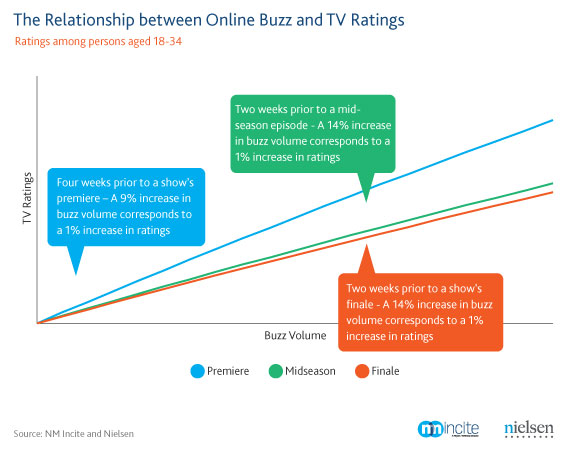
NM Incite, a Nielsen/McKinsey Company, worked with Nielsen to try to better answer that question. In the study, NM Incite and Nielsen were able to find a statistically significant relationship that shows a correlation between online buzz and TV ratings. This correlation takes place throughout the TV show season, though the impact online buzz can have on ratings can vary based on a season’s timeline.Unsurprisingly, the strongest correlation takes place with younger demographics, viewers ages 12-17 and 18-34. Nielsen and NM Incite also found a slightly stronger correlation for women over men.
via Study Shows Correlation Between Social Buzz and TV Ratings.
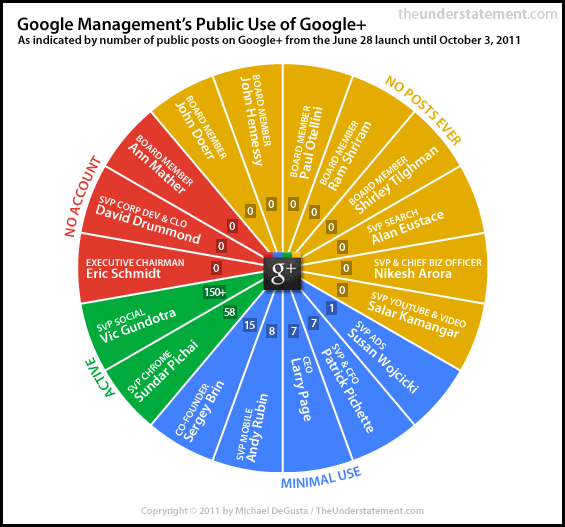
Let’s start out with addressing a few caveats. First, these senior Googlers could be posting a ton privately and we simply don’t know it. But it’s more likely that their lack of public engagement is indicative of their lack of engagement overall. This is especially true of Google’s management, which has an incentive to promote Google+ publicly.
You could also argue that the SVP of search or ads shouldn’t be expected to be heavily engaged on Google+, but given the fact that Google intends to integrate Google+ into everything it does, I don’t buy that argument either. When Google+ first launched, Gundotra told me personally that Google+ is an extension of Google itself, thus why the company chose the name.
It doesn’t matter how you slice it: if Google’s management truly believed in Google+ as the future of the company, they would be more engaged. Not being connected to a product that has such a direct correlation to the company’s future is dangerous. This is about leading by example. Why should Google employees be excited about Google+ if their managers aren’t excited?
via If Google’s Management Doesn’t Use Google+, Then Why Should You?.