May 092012
 

Karen McGrane warns about the dangers of content forking and tells us that the problem responsive design is trying to solve is really a problem with the CMS

The experience of using a mobile website should naturally be different from a desktop experience – not just visual presentation, content should be prioritised and structured differently. The risk, though, is that you’ll wind up maintaining different versions. News flash: this will be a disaster. Duplicate content. Out-of-sync updates. Wasted effort.

When usability pioneer Jakob Nielsen argued that you should “Build a separate mobile-optimised site (or mobile site) if you can afford it” where you cut features and content “that are not core to the mobile use case”, many within the mobile design and development community got out their torches and pitchforks. Seems like people who spend a lot of time thinking about mobile agree that a separate mobile website is “180-degrees backward”.

But what does a “separate mobile website” even mean?

Whether you’re talking about content or code, what you want to guard against is creating multiple versions of your website. It’s called forking, and it’s a forking nightmare from a maintenance perspective. If you fork your website into separate mobile and desktop versions, then you’re stuck updating both of them every time there’s a change. Avoiding this problem is tricky, even with sophisticated content management systems. But before we get there, let’s start with a simple scenario.

via A separate mobile website: no forking way | Opinion | .net magazine.


May 082012
 

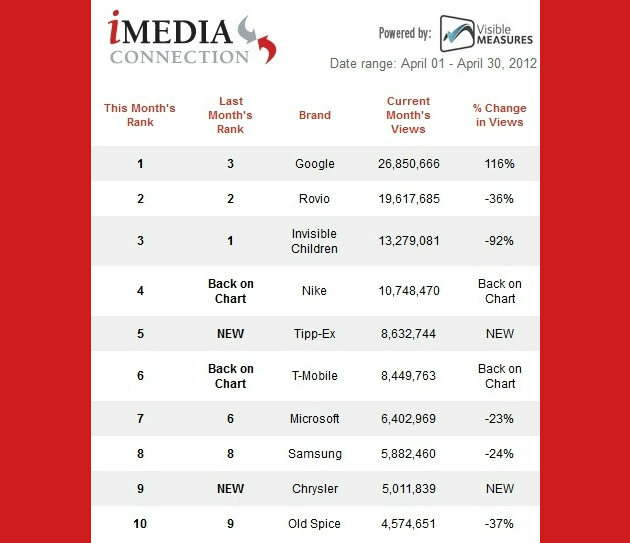
In April, the Top Brands in Video chart saw debuts from Chrysler, a long-established American brand, and Tipp-Ex, a lesser-known European brand aiming to make an impact in social video. Additionally, Nike and T-Mobile made comebacks after short hiatuses from the top 10 slots.

Powered by data from Visible Measures, this monthly chart looks at the most-watched brands in online video, across all of their campaigns.

SOURCE: The top 10 hottest brands in online video (single page view) – iMediaConnection.com.


May 072012
 

Try to guess America’s most engaging social network. Facebook? Wrong. Twitter? Wrong. Pinterest? Wrong again. According to comScore‘s most recent social networking data, from the month of March, the San Francisco based site Tagged engages users like no other service. It was the only site to finish in the top two in both of comScore’s engagement metrics.

Tagged users visited an average of 18 times each during March according to ComScore, second only to Facebook’s average of 36 visits per vistor. And each time a Tagged user visited the site, he or she stuck around for 12.1 minutes — which trailed only Tumblr 14.7 minutes and beat out Facebook 10.9 minutes.

Tagged co-founder and CEO Greg Tseng says he’s happy about ComScore’s March data, but that his company has been among America’s most engaging social networks for about a year now. The secret to Tagged’s success? A pivot Tseng and co-founder Johann Schleier-Smith made around the beginning of 2008.

SOURCE: Whats Americas Most Engaging Social Network? Youll Be Surprised.


May 042012
 

Facebook is slated to set its price range for its initial public offering (IPO) at $28 to $35, according to an amended filing with the Securities and Exchange Commission (SEC) first reported by the Wall Street Journal on Thursday. The company is expected to be publicly listed on the NASDAQ exchange on May 18 under the ticker symbol “FB.”

“Facebook, Inc. is offering 180,000,000 shares of its Class A common stock and the selling stockholders are offering 157,415,352 shares of Class A common stock,” the company wrote in the S-1 filing.

“We will not receive any proceeds from the sale of shares by the selling stockholders. This is our initial public offering and no public market currently exists for our shares of Class A common stock. We anticipate that the initial public offering price will be between $28.00 and $35.00 per share.”

However, one WSJ reporter also noted on Twitter that some investors, including Peter Thiel (founder of PayPal and venture capitalist), Microsoft, Greylock (another VC firm), and CEO Mark Zuckerberg himself are already looking to cash in to some degree before the IPO on non-public stock that they had held so far.

At the listed opening price range, the company is expected to raise over $13 billion, and would put its market capitalization, or estimated total worth, in the $77 to $96 billion range, just shy of Amazon’s current value and about twice that of HP’s. But that’s still relatively low compared to the Silicon Valley titans. By comparison, Google’s market cap is at about $200 billion, and Apple is hovering around $540 billion.

SOURCE: Facebook announces initial IPO price range of $28 to $35.


May 042012
 

The 60 new templates are designed for work, home, school, fun, holiday, and more. Examples of some of the types of templates include resumes, newsletters, recipes, photo sharing, and legal invoices.

Google has worked on vast improvements to its word processing program since it launched in 2007, including the addition of more than 200 updates to the core apps suite in the past year. These changes are apparently causing some users to make the switch from Microsoft Word.

Other Google Docs announcements from today include more options for inserting images into documents, charts in spreadsheets now have support for minor gridlines and customization, and users can set the default page size for new documents.

SOURCE: Google Docs boasts 450 new fonts and 60 new templates | Internet & Media – CNET News.


May 022012
 

Police in Biloxi, Mississippi received a disturbing report in the summer of 2011: someone using the e-mail address dalton.powers1@yahoo.com had been contacting young girls in the area through Facebook. “Dalton” said he was new to Biloxi and was looking for friends. When girls aged 9-16 responded, he struck up conversations. These led quickly to a question game in which he asked the girls about their bra sizes, sexual experiences, and bodily imperfections.

When girls responded, Dalton then demanded that they go further and send him topless images. If they did not, he would take the information provided by the girls themselves and send it to their parents, friends, and school officials. Numerous girls complied, though some could only bring themselves to pose in their underwear. Nearly every shot came from the cameras on the cell phones each girl owned.

Of course, a single picture wasn’t enough. Dalton demanded that those in their underwear send him topless shots, that those already topless send him fully nude shots, and that those who had posed nude send him live webcam footage of sexual activity. Some girls, even very young ones, did so in order to avoid further embarrassment.

Parents complained to police after several girls revealed what had been happening. “They didn’t want to play his game anymore,” Biloxi police Detective Donnie Dobbs told a local paper recently.

Connecting Facebook accounts and e-mail addresses to an IP address is trivial; connecting those IP addresses to real-world Internet subscribers is no harder. So the Biloxi police had little difficulty tracing Dalton to a house on Melbourne Circle in Montgomery, Alabama.

The only problem: while IP address lookups may be accurate, they never identify people. And the family living in the house on Melbourne Circle certainly hadn’t been conducting criminal extortion on Facebook. So what was going on?

SOURCE: How a fake Justin Bieber “sextorted” hundreds of girls through Facebook.


May 022012
 

Today’s web does not limit the act of curation to those with a doctorate degree. Anyone and everyone can, and do, curate using everything from bookmarking sites to social networks. “Social curation,” as we call it, is simply the act of sharing, categorizing, and spreading content to others. The content can be your own or someone else’s. And, because you are sharing content that lives in its place of origin via linking, it is not considered stealing.

Why do people spend hours online bookmarking, pinning, and reposting? The answer is different for everyone, but we can be sure that it’s for the same reason a woman might show off her shoe closet to a friend to hear, “OMG, those are so cute where did you find these?!” Or, a man might sit through an entire dinner carefully talking through the history of aviation and the ins and outs of his profession. We all want to be recognized for our expertise, talents, and savvy. Posting content we care about displays our creativity, interests, opinions, and personality. Being social creatures, we naturally want to share the best of things with our circles and get recognition for the good find. On the receiving end, people enjoy discovering and exploring things that are highly relevant and interesting.

Of course, when human behavior shifts, brands are quick to follow suit. In this article, we’ll discuss how marketers can get in on the social curation boom in a meaningful way.

There are a lot of websites out there offering curation-type services. They crop up and disappear with the latest craze. To get a clear sense of how a brand might leverage curation, we can break them down into categories.

SOURCE:  8 social curation tricks for Pinterest and beyond (single page view) – iMediaConnection.com.


May 012012
 

Some musicians and record executives have recently bemoaned the fact that what ends up on a fans iPod or iPhone is of arguably much lower quality than what is laid down on tape or hard drives in the studio. While some players in the industry have pushed for higher resolution downloads, Apples current solution involves adhering to long-recognized—if not always followed—industry best practices, along with an improved compression toolchain that squeezes the most out of high-quality master recordings while still producing a standard 256kbps AAC iTunes Plus file.

Shepard applauded Apples technical guidelines, which encourage mastering engineers to use less dynamic range compression, to refrain from pushing audio levels to the absolute limit, and to submit 24/96 files for direct conversion to 16/44.1 compressed iTunes Plus tracks. However, he doubted that submitting such high quality files would result in much difference in final sound quality. Shepards conclusions led CE Pro to claim that Mastered for iTunes is nothing more than “marketing hype.”

So, we set out to delve deeper into the technical aspects of Mastered for iTunes. We also attempted to do some of our own testing to see if there was any difference—good or bad—to be had from following the example of Masterdisk.

SOURCE: Does “Mastered for iTunes” matter to music? Ars puts it to the test.


Apr 272012
 

 Mass market paperbacks may be taking a serious hit in sales these days, but check out this infographic showing the explosive growth in e books.

Online Marketing Trends: Digital E Books See 117% Increase..

Apr 252012
 

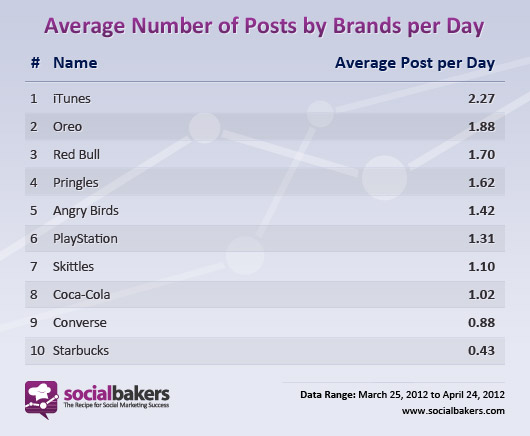
To engage your fans, you need to post enough content but not too much at the same time. Is there a magical number for the ideal number of posts on Facebook?

No, there is no magical number. The average number of posts tends to range between 2 – 3 posts a day but there are just too many factors that affect the engagement of a post to say that it works for each brand. So what is the right frequency?

Below are the average numbers of posts per day by the top 10 Brands and Media on Facebook. We have gathered data from last month, from March 25th to April 24th 2012.

SOURCE: How Often Should You Post On Your Wall To Engage Fans? – Socialbakers.