Sep 222011


The company did some internal research and found that users, especially younger ones, were afraid to “Like” because of the implied endorsement. Less Liking, or sharing, means less interesting content on Facebook and fewer posts about what these users are doing.

Facebook’s bet is that more people will click a button that says they’ve “Listened” to a song or “Watched” a video, rather than simply liking it. That’s why Facebook will be rolling out “Watched,” “Listened” and “Read” buttons, as has been previously reported. But at Facebook’s f8 conference, the company will give developers the power to create their own actions.

via How Facebook Will Fix Its Like Button Problem.

Sep 202011


We always knew gamers had serious smarts, but now the rest of the world knows it, too. Gamers have been listed alongside scientists as responsible for cracking the code of how an enzyme of an AIDS-like virus is put together.

The accomplishment, chronicled in a recent issue of Nature Structural & Molecular Biology, is a puzzle that has stumped science for well over 10 years. The enzyme M-PMV, in the protease family, is key in the molecular structure of retroviruses that causes AIDS in simians and includes HIV. Understanding how a virus is put together is a major leap towards understanding how to construct drugs to combat disease.

via Scientists unravel AIDS virus mystery with unlikely ally: gamers | DVICE.

Sep 202011


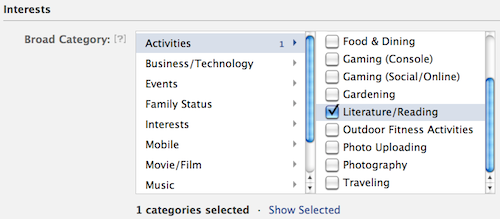
Facebook will add new feedback buttons to stories in the news feed, according a TechCrunch source. Starting with “Read”, “Listened”, and “Watched” buttons, users will be able to indicate that they’ve already consumed a piece of content. This will allow them to provide more specific information about how they’re related to different types of content, which could help Facebook refine the news feed to show them more of similar types of content. The tip matches with the tagline “Read, Watch, Listen” which AllThingsD heard will be used for the f8 conference.

via Facebook’s Rumored Read, Listened, and Watched Buttons: A Money-Making Fit With Broad Category Ad Targeting.

Sep 162011


Boston Globe has launched a snazzy new website, in an attempt to create a more immersive news-reading experience, on a platform that appropriately features long-format journalism and better promotes a subscription-based business model. That’s all lovely for readers, but the site also has a modern, adaptive design that will make many web designers swoon (or go green with envy).

Load up the site and drag the window about; note how the newspapery and readable design effortlessly reworks its columns, and how the navigation works in its narrowest form. Lovely. We wanted to find out more, so quizzed some of the people behind the build: Filament Group’s partner Patty Toland and two designer/developers, Scott Jehl and Mat Marquis.

via Behind Boston Globe’s responsive layout | News | .net magazine.

Sep 162011
 

Google is giving preference to single-page versions of a web page as opposed to component pages that contain only a portion of the information, forcing the user to click to “next” and load another URL.

Paginated content, in other words, can be counted as another factor it likely considers in search rankings.

via Google’s Gripe Against Paginated Content – MarketingVOX.

Sep 162011


Hard drives are getting bigger and faster every year, but they’re just barely keeping pace with the rate at which our data are expanding. A new service called Bitcasa wants to be the last hard drive you ever need, by offering seamless and infinite (infinite!) cloud-based storage for all of your data.

Bitcasa is a simple concept: a little piece of software lives on your computer and creates a virtual drive by connecting to Bitcasa’s servers. Every time you save something to that drive, it goes off to live in the cloud, and you never run out of drive space. Bitcasa will figure out what files you use most often and keep them local for fast access, but in general, you’re simply not storing any data on your computer.

via New cloud service gives you ‘infinite’ HD space for $10/mo | DVICE.

Sep 162011


Today Google launched the beginnings of an API for the company’s Google+ social network.

APIs allow outside developers to connect with and build applications on top of web services like Facebook, Twitter and now Google+. In fact much of the success of Twitter and Facebook is a result of both services’ developer APIs. If Google+ is to have any hope of catching its competitors it needs a strong API.

via Google Rolls Out a Developer API for Google+ | Webmonkey | Wired.com.

Sep 162011


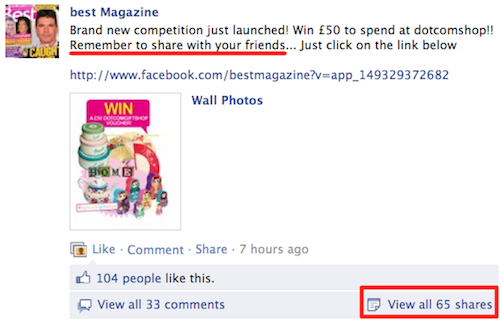
Facebook news feed updates by both users and Pages display a “Share” button that lets users repost that update to their friends. Updates that have been reposted at least once display a count of how many times they’ve been reposted next to a link labeled “View Shares”. This link helps posts stand out in the feed and indicates to your audience that other users thought the update was important and its therefore worth reading, clicking or reposting. Its important for you to solicit Shares of your updates so they receive this distinction.

Here we’ll walk-through how the View Shares link works, and provide strategies for how you can attain Shares and the benefits they bring for your business.

via How to Get Users to Repost Your Facebook Page’s News Feed Posts Through the Share Button.

Sep 162011
 

Designing a great user interface can be a challenge, even for the most seasoned designer. Countless factors need to be taken into consideration and the difference between a good UI and a great one often boils down to paying close attention to the smallest details.

When undertaking such an important and often complex task, it’s helpful to have some handy resources for both education and inspiration. We’ve put together a list of some of our favorites below. Since we can only scratch the surface of the wide variety of UI design resources available, we invite you to share yours in the comments.

via 9 Essential Resources for User Interface Designers.

Sep 162011


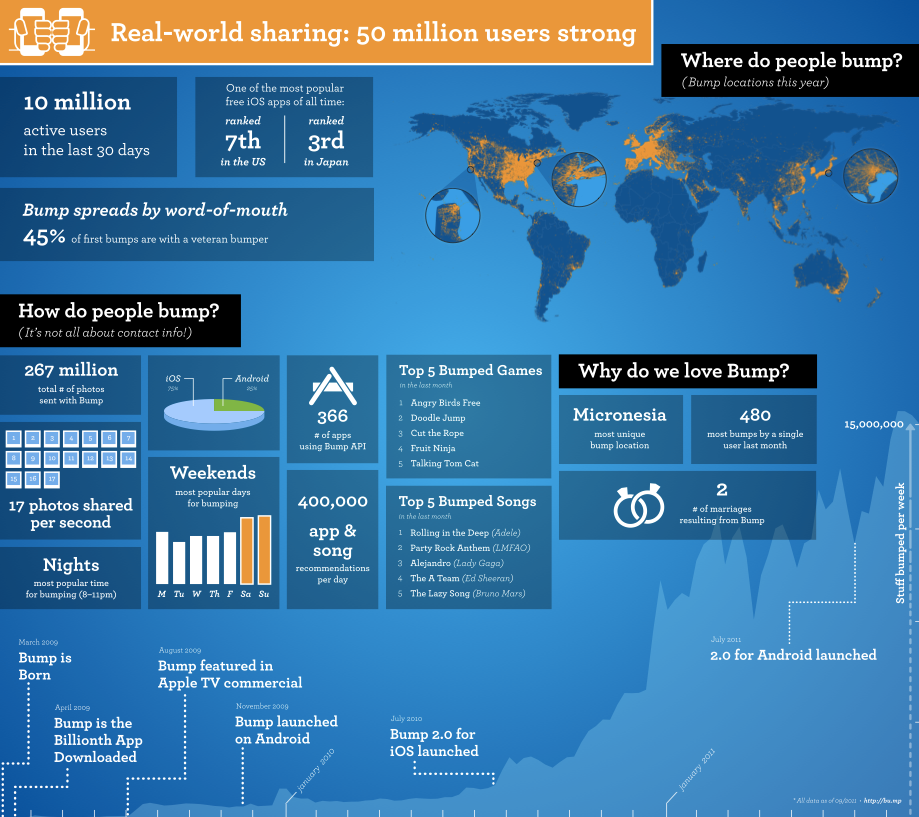
Bump, the app that makes it simple to exchange information between mobile devices, has surpassed 10 million active users and 50 million downloads.

The company’s technology allows two users to “bump” their phones and exchange contact information. With the iOS and Android apps, users can also friend or follow each other on LinkedIn, Twitter and Facebook. And late last year, the company introduced a way to share music by bumping.

via Bump Hits 50 Million Downloads; What’s Being Shared? [INFOGRAPHIC].