
May 232012
 

Rather than challenge Facebook and Twitter for mindshare, Google is a distant fourth to Pinterest, with its “pin it” button now appearing alongside Facebook, Twitter and email buttons on prime web real-estate such as eBay and Amazon product pages.

Google has never been able to ” succeed ” in any of its social media initiative and this infographic makes it  clear why .

Nissan, was among the biggest  brands on Google plus  for having one of the best new Google+ brand pages, even down to the animated GIF in its header image that gives the illusion of a car speeding by. Nearly 424,000 users have added the page to their “circles” Google+ lingo for following a person or brand and yet Nissans agency decided early on not to invest in developing content specifically for the page, which mostly contains repurposed content from Facebook.

“The bottom line was that it was pretty bleak in its traffic,” said Brandon Kleinman, director of social media and strategy at TBWA/Chiat/Day.The broad consensus is that Google+ is an empty city where the masses go to set up a profile but then seldom return.

SOURCE   Online Marketing Trends: Brands Flock To Pinterest, as Google plus sink to new low.


May 212012
 

Are you constantly hitting refresh on your favorite site or spend countless hours surfing the web? If you answered yes, you may be depressed.

Internet usage was shown to vary between people who showed signs of depression and people who had no signs of depression. People who had symptoms of depression were more likely to use file-sharing programs and seemingly cruise around sites at random.

Researchers led by Sriram Chellappan from the Missouri University of Science and Technology, collected internet usage data from 216 college students enrolled at the university. The usage data was collected anonymously without interfering with the student’s normal internet usage for a month.

The students were tested to see if they had symptoms of depression and analyzed internet usage based on the results. Depressed students tended to use the internet in much different ways than their non-depressed classmates.

Depressed students used file-sharing programs, like torrents or online sharing sites, more than non-depressed students. Depressed students also chatted more and sent more emails out. Online video viewing and game playing were also more popular for depressed students.

SOURCE Medical Daily: Depressed People Surf the Web Differently.


May 212012
 

According to a recent poll by the Associated Press and CNBC, 46 percent of respondents think Facebook will “fade away as new things come along.” That’s an ominous data point for a company whose IPO dominated the news cycle last week, and claims some 900 million worldwide users.

Facebook seems to be infiltrating every facet of our lives. “Like” buttons appear on every website. “Like us on Facebook!” shouts at us during TV commercials. And more and more apps rely on Facebook to simply log in. It’s starting to feel more than a little oppressive — it’s like we’re living in a blue-and-white-painted jail cell.

And all this IPO madness is just foul icing on the cake.

So where do you turn when the world’s been stricken with Facebook fever? We rounded up seven apps that could satisfy your social networking needs should Facebook go down the tubes — or you just can’t take it anymore.

SOURCE 7 Social Networking Apps for When Facebook Jumps the Shark | Gadget Lab | Wired.com.


May 212012
 

Jon Steinberg, BuzzFeeds president, notes that visitors to BuzzFeed simultaneously engage with an endless mashup of high- and low-brow content, from news to wacky animal photo montages. All categories of content are welcome, Steinberg says, so long as they meet BuzzFeeds simple threshold — is it shareable?

According to Steinberg, brands that work with BuzzFeed need to consider three things when figuring out how to create content worth sharing.

  • Does the content have a voice or point of view?
  • Is it a content gift?
  • What does the content do for the brand?

While the last question might seem obvious to anyone who works in advertising, the first two questions are a big part of what makes BuzzFeed such a unique play for marketers. Brands cant buy banners ads, although they can purchase placement for their post in a given vertical. But theres a catch — the content has to be good. If it is good, people will share it. If its a dud, BuzzFeed has an algorithm in place to swap it out for something better.

With just under 3 million unique visitors a month — and climbing, according to Compete — BuzzFeed is clearly a careful steward of its content ecosystem. It also tends to be way ahead of the viral curve. As any BuzzFeed user can tell you, what you see on BuzzFeed today will likely be on Facebook tomorrow. Naturally, thats a huge draw for brands looking to make a social media splash. But engaging with social media takes more than just showing up. So to help marketers reimagine themselves as social publishers, were showcasing five brands that have figured out how to buzz on BuzzFeed.

SOURCE How 5 brands are scoring big on BuzzFeed single page view – iMediaConnection.com.


May 182012
 

Research shows that local search listings are now more important than any other type of listing because they provide the information searchers want quickly (URL, address, phone, coupons, operating hours, reviews, etc.). Local search listings were also found to be trustworthy because they immediately provide the relevant information consumers need to make a purchase decision.

Done in partnership by Localeze and 15miles, the 2012 Local Search Usage Study, conducted by comScore, found that 61 percent of respondents searching for local business information believe local search results are the most relevant, as shown in the chart below. Additionally, 58 percent found local search results to be the most trustworthy when compared to natural search results, paid search results, and paid results.

Gone are the days of “surfing the web.” Today’s consumers want to find information quickly, and they search with a purpose. They want to find information in the shortest time possible since many of them search on the go. By 2014, more users will access the web from mobile devices than from desktops and laptops — a shift that continues to accelerate.

Relevant local search results

With national advertisers dominating paid search, consumers searching the web for a local business near home will often get the closest national chain, which may or may not be the closest option. This leaves consumers dubious about web search because merchants close by are not found at the top.

This is why consumers go to local search, which has business listings and provides the best way for consumers to connect with businesses close to where they live and work. The popularity of location-based apps and social networks make it even more important for search results to produce business listings based on a searcher’s location. Needless to say, these listings must be accurate in providing phone numbers, directions, and so forth.

SOURCE  Why consumers can’t find you online – iMediaConnection.com.


May 162012
 

Social media is constantly evolving, and with this evolution, there are more opportunities than not to misstep. A campaign on social media has hundreds of ways it can go wrong, and most of them are unpredictable. Of course, it’s important to be as prepared as possible, but sometimes, social media fails are bound to happen. After all, we’re only humans managing accounts for brands, right? Learning from others’ mistakes is a great place to start, and some of us lucky ones have learned the hard way. Here are a few examples of the social media campaigns that turned total flop.

SOURCE: 5 brands that embarrassed themselves on social (single page view) – iMediaConnection.com.


May 162012
 

So we hooked the Pizza Delicious guys up with Rob Leathern a social media ad guru.

The key question they tried to answer: Which Facebook users should they target with their ad campaign?

Their first idea was to target the friends of people who already liked Pizza Delicious on Facebook. But that wound up targeting 74 percent of people in New Orleans on Facebook — 224,000 people. They needed something narrower.

The Pizza Delicious guys really wanted to find people jonesing for real new york pizza. So they tried to target people who had other New York likes — the Jets, the Knicks, Nororious B.I.G. Making the New York connection cut the reach of the ad down to 15,000.

Seemed perfect. But 12 hours later, Michael called us. “It was all zeroes across the board,” he said. Facebook doesnt make money til people click on the ad. If nobody clicks, Facebook turns the ad off. Theyd struck out.

So they changed the target to New Orleans fans of Italian food: mozzarella, gnocchi, espresso. This time they were targeting 30,000 people.

Those ads went viral. They got twice the usual number of click throughs, on average. The ad showed up more than 700,000 times. Basically, everyone in New Orleans on Facebook saw it. Twice. Pizza Delicious got close to twenty times the number of Facebook fans they usually get in two days. The guys were stoked.

The campaign cost them $240 — almost $1 for each new Facebook fan they got from the campaign. “Is that feeling of exhilaration worth 240 dollars?” Michael said. “I dont know— hopefully, that translates into new business.”

It didnt.

SOURCE: Pizza Delicious Bought An Ad On Facebook. Howd They Do? : Planet Money : NPR.


May 152012
 

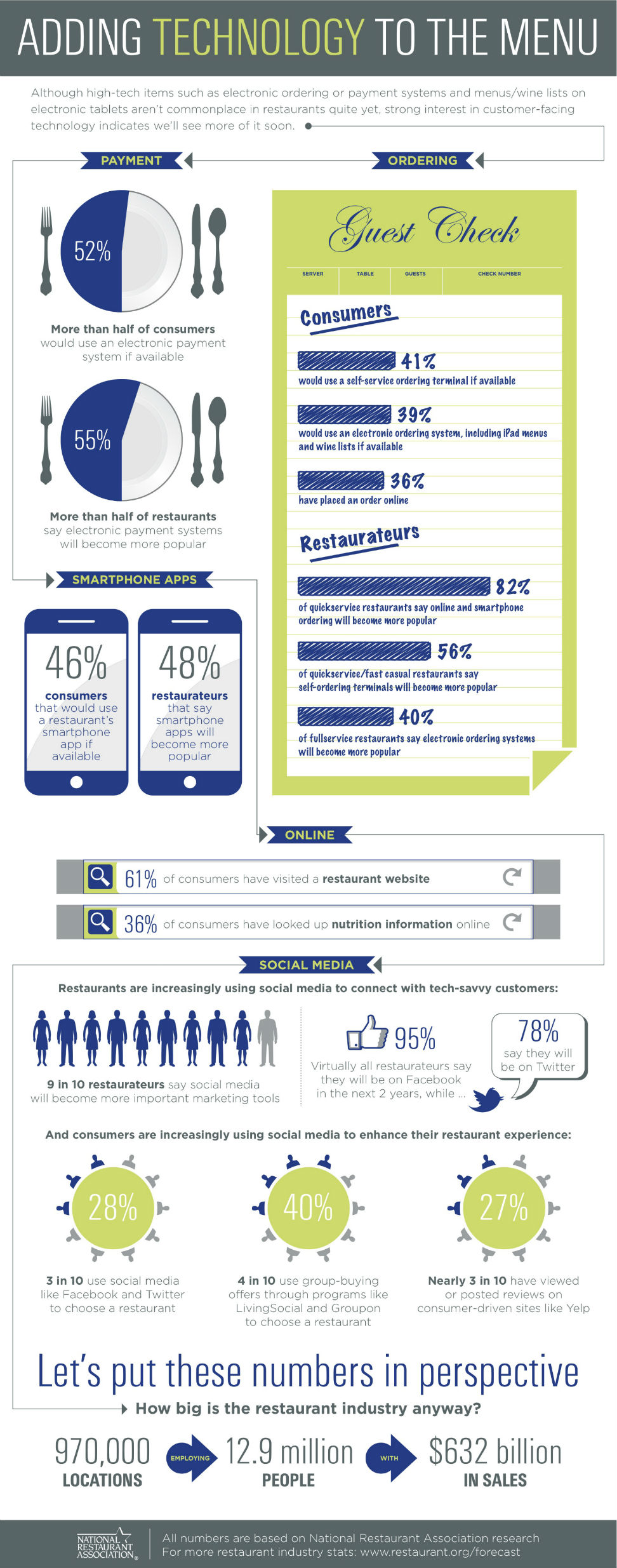
Before setting foot outside, about 45% of consumers have already chosen where to eat with the help of an online dining guide. Online reviews are a huge decider of what’s for dinner — 57% of patrons rely on them.

Even more interesting is that despite the rise of online food directories such as Urbanspoon or Menupages, 41% of consumers still wine and dine at a particular restaurant after receiving a promotional email.

The National Restaurant Association drew up the infographic below showcasing how technology is changing the food industry. Plus, check out the kinds of technology consumers are expecting to see in restaurants.


SOURCE: Most Restaurant-Goers Rely on Online Reviews [INFOGRAPHIC].


May 142012
 

Anything that can boast a 112% higher engagement is worth a second look. That is just one of the figures that Simply Measured (the social media analytics firm) released yesterday. Since February, two more brands from the Interbrand Top 100 list (Xerox and Nike) have activated pages, bringing the total to 64 of those 100. (The top 10 for Google+ engagement include Nike, Coke, Starbucks, Adidas and Ferrari, among others.) Also since February, average weekly circler engagement is up 112%, and content engagement is up 65%. Finally, 22% of the brands now have circler counts over 100,000, up from 13% including Nike, and after just two months. So it appears brands are prioritizing Google+ and trying to capitalize on participation.

But, as Josh Sternberg of Digiday describes, smart brands actively strategize on Google+, rather than treat it as yet another presence they need to fill. ESPN for example has 1.2 million Google+ followers. Sports fans like rich media, and ESPN knows that, so relies on high-quality images and videos of all-things sport, and interactions with fans.

The news media seems not to know what to make of it, and the highly-circulated Wall Street Journal, New York Times and USA Today have piddling followings on Google+ compared to their other social platforms.

SOURCE: Dismiss Google+ At Your Own Risk – MarketingVOX.


May 142012
 

The geek community at large seems to be pretty loyal to the Google brand, however, out what seems like nowhere, Bing is finally picking up steam. According to a Hitwise report, Bing now accounts for 30% of all U.S. web searches, and most of their gains seem to have come at the expense of Google.

Bing has managed to grow its US search quarries by an impressive 11% over the last twelve months, while Google in contrast has dropped by the exact same amount.

SOURCE: Maximum PC | Bing Scoops Up 30% of the US Search Market.