Jul 022012
 

The search giant today unveiled its 2011 Economic Impact report, and said that its search and advertising tools, including AdWords and AdSense, drove $80 billion in economic activity across the U.S. last year. The company was able to reach that figure with help from “1.8 million businesses, Web site publishers, and non-profits across the U.S.”

In order to arrive at that figure, Google used some fancy math. The company estimates that businesses that use AdWords make $2 in revenue for every $1 they spend on the advertising platform. In addition, the company assumed that a business will receive five clicks in search results for every one click on their ads.

MORE: Google: We drove $80 billion of U.S. economic activity last year 


Jun 222012
 

If you dig through the last 60 years of industry research, you’ll find the reasons for product failures are heavily influenced by customer “fit” issues. That means there is a mismatch between what the customer wants and what the product offers. The pricing might be wrong. Or the product might lack clear differentiation. Or it might lack an important feature, or be too difficult to use. While it is true that products fail for a lot of reasons, it is also true that most products fail simply because customers don’t see value in them. The value proposition is weak or non-existent.

When something is “viable,” it is capable of not only germinating, but growing. In product development terms, viability means that a product not only gets purchased, but it performs well enough to be recommended to others. Its popularity spreads organically, or virally. You want a product that both initiates a sale and generates word of mouth.

There are formal research tools designed to get at the issue of viability, with familiar names like concept testing, prototype testing, test markets, and focus groups, but they can be complex, expensive and time-consuming.

There are also Agile teams. One of the hallmarks of an Agile team is regular and direct customer interaction by developers themselves. This is principle number one in the Agile Manifesto, and third-party research is rarely a good substitute.

In the Agile world, after team members interact with customers they bring back what they learned to the group, implications are discussed collectively, and product enhancement decisions are made very quickly. This sets the stage for yet another round of iteration. This decision cycle moves at what I call “Agile Time,” (read: fast) and any supporting tools or techniques have to conform to or accelerate the process. These decisions are made using “soft” data, and mostly gut instinct. They are not easy to monitor.

MORE:  What it Takes to Make Your Product Viable.


Jun 042012
 

The latest entry in agency self-promotion comes from Fort Worth, Texas-based GCG Marketing which just released a beatnick poet/rap-style video that’s filled with all the usual superlatives and buzzword bingo you’d expect from an agency pimping itself. It’s not necessarily the fact that anything said in this video is untrue. The problem is that it, and other work like it, simply brings to light the mostly inconsequential, insignificant and irrelevant nature of an ad agency and what it stands for. In the greater scheme of things, advertising is pure puffery when compared to the important things in life that really matter.

And when an agency calls attention to the inconsequential, the insignificant and the irrelevant, it simply devalues the subject matter even further. It’s akin to watching two siblings fight over an heirloom your grandmother left you until it is torn apart into pieces that slowly fall to the ground as you all, bickering children included, realize the memory it represented is now forever tarnished. It’s truly that painful.

So please, agencies, do what you do best: create sustainable, inspiring ideas for others. The result of that creativity are what should act as your ongoing self-promotional effort. Not a platitude-filled music video.


SOURCE Agencies Continue to Embarrass With Self Promomotional Videos – Adrants.


May 222012
 

It can be rather tempting for brands and causes to shake things up by making shocking marketing messages that cause visceral reactions. Some brands have gotten great business mileage out of this approach. Others have found themselves in deep doo-doo as consumer blowback undermined their messages and integrity.

In the following pages, you will find nine examples of shocking brand messages. Five seem to work in that they garner strong reactions, but largely of a positive nature. Four had some really bad brand consequences. Well sum up with some conclusions on what works and what doesnt.

SOURCE  9 shocking ads and how they fared single page view – iMediaConnection.com.


May 212012
 

Jon Steinberg, BuzzFeeds president, notes that visitors to BuzzFeed simultaneously engage with an endless mashup of high- and low-brow content, from news to wacky animal photo montages. All categories of content are welcome, Steinberg says, so long as they meet BuzzFeeds simple threshold — is it shareable?

According to Steinberg, brands that work with BuzzFeed need to consider three things when figuring out how to create content worth sharing.

  • Does the content have a voice or point of view?
  • Is it a content gift?
  • What does the content do for the brand?

While the last question might seem obvious to anyone who works in advertising, the first two questions are a big part of what makes BuzzFeed such a unique play for marketers. Brands cant buy banners ads, although they can purchase placement for their post in a given vertical. But theres a catch — the content has to be good. If it is good, people will share it. If its a dud, BuzzFeed has an algorithm in place to swap it out for something better.

With just under 3 million unique visitors a month — and climbing, according to Compete — BuzzFeed is clearly a careful steward of its content ecosystem. It also tends to be way ahead of the viral curve. As any BuzzFeed user can tell you, what you see on BuzzFeed today will likely be on Facebook tomorrow. Naturally, thats a huge draw for brands looking to make a social media splash. But engaging with social media takes more than just showing up. So to help marketers reimagine themselves as social publishers, were showcasing five brands that have figured out how to buzz on BuzzFeed.

SOURCE How 5 brands are scoring big on BuzzFeed single page view – iMediaConnection.com.


May 182012
 

Research shows that local search listings are now more important than any other type of listing because they provide the information searchers want quickly (URL, address, phone, coupons, operating hours, reviews, etc.). Local search listings were also found to be trustworthy because they immediately provide the relevant information consumers need to make a purchase decision.

Done in partnership by Localeze and 15miles, the 2012 Local Search Usage Study, conducted by comScore, found that 61 percent of respondents searching for local business information believe local search results are the most relevant, as shown in the chart below. Additionally, 58 percent found local search results to be the most trustworthy when compared to natural search results, paid search results, and paid results.

Gone are the days of “surfing the web.” Today’s consumers want to find information quickly, and they search with a purpose. They want to find information in the shortest time possible since many of them search on the go. By 2014, more users will access the web from mobile devices than from desktops and laptops — a shift that continues to accelerate.

Relevant local search results

With national advertisers dominating paid search, consumers searching the web for a local business near home will often get the closest national chain, which may or may not be the closest option. This leaves consumers dubious about web search because merchants close by are not found at the top.

This is why consumers go to local search, which has business listings and provides the best way for consumers to connect with businesses close to where they live and work. The popularity of location-based apps and social networks make it even more important for search results to produce business listings based on a searcher’s location. Needless to say, these listings must be accurate in providing phone numbers, directions, and so forth.

SOURCE  Why consumers can’t find you online – iMediaConnection.com.



May 162012
 

Social media is constantly evolving, and with this evolution, there are more opportunities than not to misstep. A campaign on social media has hundreds of ways it can go wrong, and most of them are unpredictable. Of course, it’s important to be as prepared as possible, but sometimes, social media fails are bound to happen. After all, we’re only humans managing accounts for brands, right? Learning from others’ mistakes is a great place to start, and some of us lucky ones have learned the hard way. Here are a few examples of the social media campaigns that turned total flop.

SOURCE: 5 brands that embarrassed themselves on social (single page view) – iMediaConnection.com.


May 162012
 

With the cosmetics and hair care brand, they did a deep dive into data to discover what women were actually searching for when they thought about beauty and discovered a huge number of people were typing specific questions into google, like “how can I do my makeup like Lady Gaga?” In response, Demand worked to produce 1,126 videos in a matter of months and on a budget, each addressing a common “how to” search query.

Some key takeaways from this panel presentation:

– Search queries are getting longer – often ten words are more. People are looking for very specific content when they search, and if you can provide it, that’s a huge service.

– The best videos for this sort of marketing are “evergreen” – that is, they remain relevant for a long time (3-5 years) by containing generally useful content, rather than being attached to a trend, celebrity, or launch. A light touch on the branding also helps the videos feel authentic, and not tied to very specific products so much as the brand.

– If your brand is traditional, start with a test – produce just a few examples of the new content type and see how they perform in search and on your site. Success is your best shot at convincing the old guard to try new tactics.

– Social listening is of the utmost importance – in fact, L’Oriel has changed their call centers into customer listening and insight hubs. Understanding what people are saying about your products, and the surrounding industry, allows you to channel feedback to the right people and meet actual demand.

– Data is the key to staying on top as trends change – know where the landscape is headed, not just what’s working now.

SOURCE: How Brands Can Meet Consumer Demand With Content – Adrants.


May 162012
 

So we hooked the Pizza Delicious guys up with Rob Leathern a social media ad guru.

The key question they tried to answer: Which Facebook users should they target with their ad campaign?

Their first idea was to target the friends of people who already liked Pizza Delicious on Facebook. But that wound up targeting 74 percent of people in New Orleans on Facebook — 224,000 people. They needed something narrower.

The Pizza Delicious guys really wanted to find people jonesing for real new york pizza. So they tried to target people who had other New York likes — the Jets, the Knicks, Nororious B.I.G. Making the New York connection cut the reach of the ad down to 15,000.

Seemed perfect. But 12 hours later, Michael called us. “It was all zeroes across the board,” he said. Facebook doesnt make money til people click on the ad. If nobody clicks, Facebook turns the ad off. Theyd struck out.

So they changed the target to New Orleans fans of Italian food: mozzarella, gnocchi, espresso. This time they were targeting 30,000 people.

Those ads went viral. They got twice the usual number of click throughs, on average. The ad showed up more than 700,000 times. Basically, everyone in New Orleans on Facebook saw it. Twice. Pizza Delicious got close to twenty times the number of Facebook fans they usually get in two days. The guys were stoked.

The campaign cost them $240 — almost $1 for each new Facebook fan they got from the campaign. “Is that feeling of exhilaration worth 240 dollars?” Michael said. “I dont know— hopefully, that translates into new business.”

It didnt.

SOURCE: Pizza Delicious Bought An Ad On Facebook. Howd They Do? : Planet Money : NPR.


May 152012
 

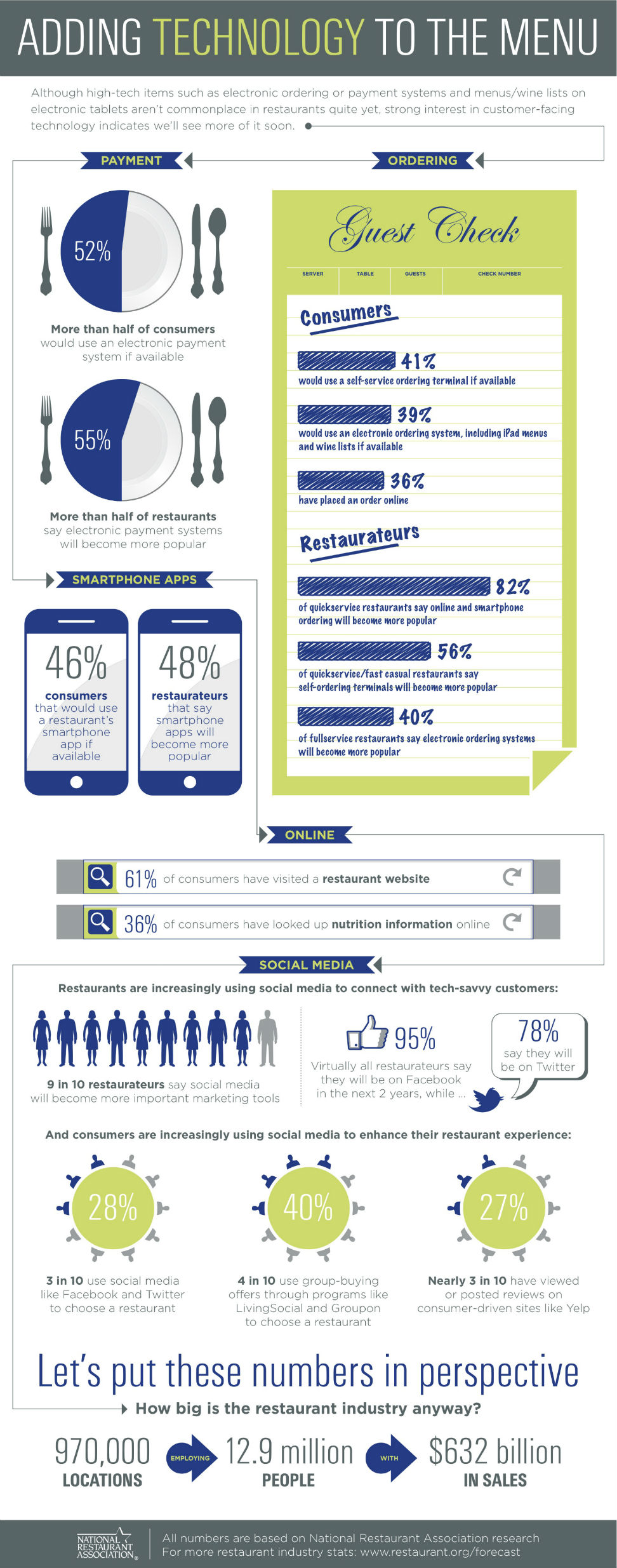
Before setting foot outside, about 45% of consumers have already chosen where to eat with the help of an online dining guide. Online reviews are a huge decider of what’s for dinner — 57% of patrons rely on them.

Even more interesting is that despite the rise of online food directories such as Urbanspoon or Menupages, 41% of consumers still wine and dine at a particular restaurant after receiving a promotional email.

The National Restaurant Association drew up the infographic below showcasing how technology is changing the food industry. Plus, check out the kinds of technology consumers are expecting to see in restaurants.


SOURCE: Most Restaurant-Goers Rely on Online Reviews [INFOGRAPHIC].