Jul 022012
 

The search giant today unveiled its 2011 Economic Impact report, and said that its search and advertising tools, including AdWords and AdSense, drove $80 billion in economic activity across the U.S. last year. The company was able to reach that figure with help from “1.8 million businesses, Web site publishers, and non-profits across the U.S.”

In order to arrive at that figure, Google used some fancy math. The company estimates that businesses that use AdWords make $2 in revenue for every $1 they spend on the advertising platform. In addition, the company assumed that a business will receive five clicks in search results for every one click on their ads.

MORE: Google: We drove $80 billion of U.S. economic activity last year 


Jul 022012
 

Facebook appears to be testing a new “Want” button plugin similar to its popular Like button.

Developer Tom Waddington from Cut Out + Keep discovered that a Want button has been added to the Facebook Javascript SDK as an XFBML tag – <fb:wants>. The button is not publicly listed among the other social plugins on Facebook’s developer site. Waddington says the button will only work on Open Graph objects marked as “products.”

With Open Graph, developers have been able to create their own “want” actions, but users have to authorize a third-party app in order for those buttons to generate stories on Timeline and News Feed. If the Want button plugin works similarly to the Like button, users will not have to go through the step of authorizing an app. This means even more users will be likely to click it.

MORE: Facebook testing ‘Want’ button plugin.


Jun 222012
 

Facebook announced today that developers will be able to add a new Open Graph-enabled Like action to their apps so that users can easily share content back on Facebook.

Mobile and web app developers can now build custom buttons that function similarly to Facebook’s traditional Like button. For example, Instagram and Foursquare use hearts in their mobile apps. Now instead of those actions being seen within the app only, they can be published to Facebook without any additional steps. Further, when a user Likes their friend’s photo or story using the new Like action, the friend will receive a Facebook notification about it. This feature could help increase discovery and engagement of apps that integrate Open Graph.

MORE:  Facebook gives Like button functionality to third-party mobile and web app buttons.


Jun 222012
 

Thursday’s sporadic Twitter outages gave addicts like us the shakes. After all, Twitter users average over 100,000 tweets per minute, and the site was down for a whole lot longer than that.

Twitter is far from the only channel through which web users funnel data. Business intelligence company DOMO paired up with Column Five Media to create this infographic, which shows just how much data is generated every minute.

Next time you run a Google search, think about the fact that it’s just one of 2 million that Google will receive in that minute. In the same amount of time, Facebook users post 684,478 pieces of content. Crazier still, online shoppers spend an average of $272,070 every minute. That’s over $391 million every day — quite the chunk of change.

SOURCE:  How Much Data Is Created Every Minute? [INFOGRAPHIC].


Jun 042012
 

A preview of the new version of Bing has been available for some time, but as of today the new layout and features are now available to everyone in the United States. So far there’s no word on when the same features might come to international users.

If social search features leave you feeling cold, fear not, the new Bing doesn’t follow Google’s lead and integrate social results right into the main search results. Instead Bing has completely overhauled its look and now sports a three-column layout. To go along with the new layout Bing has cut back on the chrome and other UI elements so even though there’s quite a bit more info on the page, it still feels relatively uncluttered.

The new look pairs the traditional search results — still on the left side of the page — with two new columns — a so-called snapshot column in the middle, and the new social results on the far right.

The most intriguing of the three is the snapshot info, which varies according to your search.

SOURCE Microsoft Goes Social With Bing Search Overhaul | Webmonkey | Wired.com.


May 302012
 

Amazon has received intense and well-deserved criticism for working conditions in its warehouses, where temperatures can reportedly rise above 100 degrees Fahrenheit. The people working inside them are underpaid, overworked, subject to firing without cause and deprived of employee benefits. Amazon gets away with this because it uses a variety of legal tricks, like demanding that its employees call themselves “independent contractors.”

Amazon has also taken heat for its membership in ALEC—the American Legislative Executive Council—a corporate-funded group that backs right-wing politicians. ALEC also drafts and promotes laws like those that effectively disenfranchised large numbers of minority voters, the “Stand Your Ground” legislation that has resulted in the death of Trayvon Martin and a number of other people, and the anti-union laws brought to national attention by Wisconsin Governor Scott Walker.

If nothing else, Bezos offered symbolic gestures of conciliation today. He announced that Amazon would spend $52 million to install air conditioning in its warehouses and that it was leaving ALEC “because of positions they’ve taken not related to our business.”

In an even more telling sign of the impact of the protests, the normally loquacious Bezos left without taking questions from reporters.

Bezos did not announce that employees in Amazon’s warehouses would receive the benefits they’re due under state and national law, or that Amazon would stop forcing them to declare themselves independent contractors.

And Amazon was behind the curve in withdrawing from ALEC, lagging well behind companies such as KFC, Taco Bell, Coca-Cola, Proctor & Gamble, Blue Cross/Blue Shield, Intuit, McDonald’s, PepsiCo and Kraft Foods. Most of these companies left ALEC more than a month ago, when revelations about its role in “Stand Your Ground” gave renewed momentum to demands that corporations leave it.

SOURCE Protesters Confront Amazon Founder Jeff Bezos | The Nation.



May 292012
 

Bragging about your big pile of cash on Facebook isn’t a great idea.

A 17-year-old Australian girl learned this lesson the hard way last Thursday when she posted a picture of some money on Facebook. The girl was helping her grandmother count the loot and couldn’t help sharing that information with her online friends.

SOURCE Girl Posts Pics of Money on Facebook and Attracts Robbers.


May 292012
 

Fresh off Facebooks acquisition of Instagram for a whopping $1.17 billion and following a lackluster initial public offering punctuated by more fizzle than sizzle, Mark Zuckerberg and company are reportedly interested in scooping up Opera Software, the Norwegian outfit behind the semi-popular Opera browser, and the only browser maker that puts out entertaining press releases.

Word of a possible acquisition comes from Pocket-Lint.com, which is getting its information from one of its “trusted sources.” This “man in the know” tells Pocket-Lint that Facebook wants its own browser, one that would allow its users to interact with the site through baked-in plug-ins and special features on the menu bar.

SOURCE Maximum PC | Facebook Eyes Browser Acquisition, Wants to Throw an Opera Party.


May 232012
 

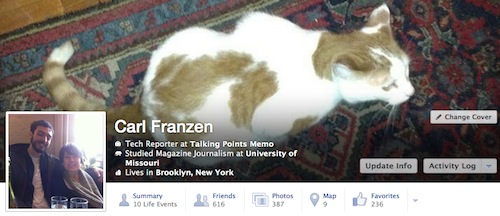
Facebook is testing a series of cosmetic changes to the top of users’ Timelines, the company has confirmed.

Screenshots of the new design were posted on Talking Points Memo Tuesday morning. The images (below) show a condensed version of Timeline, in which a user’s details (name, occupation, education, location) appear in reverse type on top of — rather than below — the cover photo.

The carousel of thumbnail images highlighting friends, photos, places, likes, etc. has also been compressed. Images are now replaced by thumbnails. Next to these, a new “Summary” section appears, presumably to highlight key events on a user’s Timeline.


SOURCE  Facebook Begins Testing New Timeline Design [PICS].